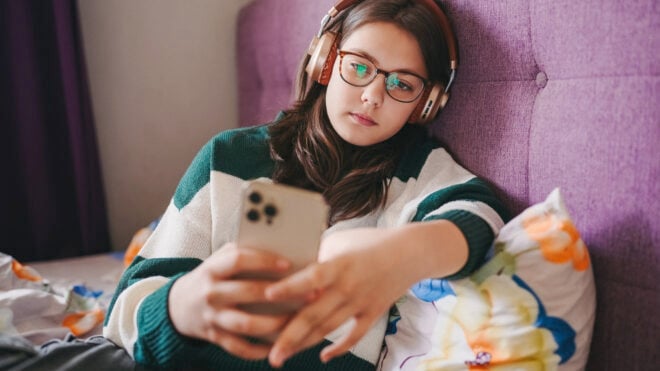

Ask a millennial to pick up the phone instead of texting, and you might be met with a face of horror. Millennials are rather infamously afraid of phone calls, preferring to take 20 minutes to download an app, register for an account, verify the account in two different ways, and then order through an app, rather than pick up the phone and order a pizza.
But is Gen Alpha the same way? Opinions about Gen Alpha seem to be mixed.
Some parents we spoke to said growing up as the first generation of kids who have always had the Internet in their lives has created an interesting paradox: They’re a generation who won’t hesitate to speak their mind online, but may struggle in face-to-face settings. “They want to be YouTube stars but will not raise their hand in class,” one mom described.
Others see a generation of kids who are more empowered than any generation to speak up for what they believe in, and tools at their disposal to do so. Mom.com did some digging to investigate Gen Alpha’s confidence levels and how we can empower Gen Alpha to feel confident in all settings.
1. Gen Alpha is More Empowered to Speak Up For Themselves

Jen Cram, co-founder of Pour Tous Skin, thinks that growing up in a world where conversations about mental health, identity, and social issues are much more out in the open has given Gen Alpha permission to use their voices early. “They see young people online advocating for things they believe in, and that normalizes it,” she says. “They don’t have the same ‘be seen and not heard’ programming that a lot of us grew up with.
Cram says as a skincare line for Gen Alpha and moms of Gen Alpha kids, they “constantly” hear from kids and tweens who tell them exactly what they want, what they like, and what they don’t. “We love that,” Cram shares. “It makes us better, and it makes the products better. That confidence to speak up is one of our favorite things about this generation.”
2. Growing Up Online Means Being Aware of Saying the 'Wrong' Thing

Leah Ringelstein, Cofounder and Director of Digital Wellness, Zigazoo, pointed out that those members of Gen Alpha who hesitate to speak up in person may be linked to their direct, firsthand awareness of how quickly saying the “wrong” thing can backfire. “Gen Alpha has grown up in environments shaped by constant feedback and visibility, which can make them more aware of judgment and sometimes hesitant to step outside the norm,” she explains.
At the same time, she countered, the same kids have unprecedented access to diverse perspectives and platforms where they can find their niche, allowing them to choose when they speak up and how they interact, at least online. In real life, that can be very different. “This creates a dynamic where they feel both the pressure of being seen and the opportunity to be heard, and many are learning to navigate both,” Ringelstein notes.
3. They May Need Practice with Confrontation
Ringelstein added that one of the reasons Gen Alpha may shy away from speaking up face-to-face is that the online environment provides a sort of “shield,” but it also provides a very simple way to step away from uncomfortable situations and feelings. If you don’t like what someone is commenting on your video or you’re in an argument with someone via text messaging, it’s very easy to step away from the conflict. You can block them, delete their comment, simply stop responding, or swipe to a new video.
“They are used to low-friction experiences and move fluidly between platforms to find what engages them,” she notes. In real life, confrontation isn’t always as easy as blocking or deleting a text, so Gen Alpha kids may need some practice with navigating those situations.
4. Building Confidence Starts with Building Good Humans

Stephanie Malia Krauss, educator and social worker, national expert on youth development, mom of two Gen Alpha children, and author of How We Thrive: Caring for Kids and Ourselves in a Changing World as well as the best-selling, Whole Child, Whole Life: 10 Ways to Help Kids Live, Learn, and Thrive, explains that building confidence in our Gen Alpha kids starts with understanding that true confidence comes from within.
She doesn’t shy away from the fact that Gen Alpha kids have had some tough challenges — and will continue to have challenges — as they grow up, which can impact their confidence in the real world. Everything from the pandemic to extreme weather to polar political climates, all in the palm of their hands, is what she calls “dangerous weather.”
“The existential risks that those pull us further and further away from the human experiences and connections that we need, they’re harmful, and so our job as parents is to intensely protect the human essentials that contribute to health, contribute to happiness, and contribute to a feeling of being whole and being able to learn,” she explains.
The good news, Krauss adds, is that we all know what the essentials to creating good humans are: “Things like play and movement and sleep, creativity, celebration, and ways of connecting as a family or connecting with friends,” she says. Cultivate the human first, and the confidence will come.
5. Sometimes, It's Our Job to Speak Up For Our Kids

As parents, we might think it’s our job to let our kids learn to speak up for themselves, and in some situations, that’s absolutely true. But Krauss points out that Gen Alpha may need parental intervention more than some other generations simply because they don’t always have the answers for what’s wrong. If a child is feeling like they don’t have a voice or not feeling confident or struggling, Krauss points out it may be because they need to go back to the “basics” of humanhood, so to speak, such as getting enough sleep or getting off screens, but in a world that is pushing more activities and more technology (AI, we’re looking at you), kids may not even know what they need.
“They’re often stuck in situations and settings that really restrict what they need to be healthy and happy and human — their basic human needs — but they don’t have the power or positionality to speak up and say, ‘I need to move my body,’ or ‘I’m so tired I need more sleep,’ or ‘I can’t focus and get something done,'” she points out, adding: “And so that does require parental intervention because we do have the power to speak up and speak out on their behalf when they cannot.”
In the end, it may be that Gen Alpha, like the millennial generation before it, is full of kids with differing levels of comfort and confidence. Some may have no problem speaking up in class, while others may prefer the shield of a screen. But it’s our job as parents and caregivers to give them the offline spaces to build confidence, no matter where they might need it.